| Home
Augusta Wisconsin was 150 years old in 2006
A Detailed Area History of Augusta
Wisconsin
History of the City of Augusta, Eau Claire Co., WI
reproduced with permission
Back to the History Page
Eau Claire County was organized in 1856. At Eau Claire there was
already quite a considerable settlement in nearby localities. Farms had been
opened up. Supplies for Eau Claire were brought by boat up the Chippewa river in
the open season, but in winter they had to be brought overland by team. Sparta,
in Monroe county, was the nearest railway station, and it was from that point
that the necessary supplies were hauled over what became known as the "old
Sparta road." This road from Sparta came through Jackson county and entered Eau
Claire county south of Augusta at the old Beef river station and continued
through what are now the towns of Clear Creek and Washington to Eau Claire. Now
all of the foregoing has been preliminary to the purpose of the present writing.
To the north of the old Sparta road was a beautiful valley through which flowed
the clear waters of a fine stream to be known thereafter as Bridge creek. In
this beautiful valley is now located the city of Augusta, the history of which
is about to be related. Augusta Wisconsin
The town of Bridge Creek, in which the city of Augusta Wisconsin is situated, consists now
of three townships and has an area of 108 square miles. The stream from which
the town derives its name flows through the town in a northwesterly direction
and marks a division line between two sections of country that are materially
different in soil, products and character.
In the spring of 1856 several families had moved into the east end of the county
and settled upon government land, but none of them on the present site of
Augusta Wisconsin. Of these early pioneers we will tell later in connection with the
history of the particular localities in which they located. That same spring,
1856, Charles Buckman and his good wife had come from Black River Falls, and
upon their arrival pitched their tent on the ground that is the present location
of the Park hotel, Augusta. Erastus Bills and his son, Sanford, also came and
began the erection near what was later known as the Brewery hill. The Buckmans
began the erection of the first dwelling, a log house, on the ground just west
of where Cox Brothers' store now stands. About this time John F. Stone and L. F.
Clarke came from Sauk county and they surveyed quite extensively and located the
site of the first industry, a sawmill, on the ground where now stands the
flouring mill of Finch, Wirth & Co. They then returned to the southern part of
the state, and in September Mr. Stone returned with his family. A young man by
the name of John C. Hacket, a carpenter by trade, came with them, and they built
a house near the present location of the home of O. Wirth.
Augusta Wisconsin
November 2, 1856, a little girl came to bless the home of Mr. and Mrs. Charles
Buckman. They named her Emma, and she was the first white child born in Augusta.
Cupid also came that year and arranged the first wedding of a couple. On January
1, 1857, Mr. John C. Hacket, the young carpenter who came with the Stone family,
and Miss Charlotte F. Stone, daughter of Mr. and Mrs. John F. Stone, went to Eau
Claire, then a thriving village twenty-five miles north- west and were there
married. The ceremony was performed by the Rev. A. Kidder in the parlors of what
was then known as the Eau Claire House, a hotel kept by a man by the name of
Drake.
These were the first white settlers of Augusta, and around them grew the hamlet
that was later to be known as Augusta. Others followed them, and the joys and
sorrows, the privations and hardships, the adversities and successes of pioneer
life came with them. Of these we shall speak hereafter.
The industrial and commercial life of Augusta Wisconsin began in the fall and winter of
1856-57. Already there were several pioneers located in the surrounding country,
now Bridge Creek, Otter Creek and Ludington. Andrew Thompson was in what was
known as Thompson valley -- named after him -- and it is said that he located
there in 1854. However this may be, his shanty in 1856 was a fragile affair with
one side wholly open, and he kept it warmed that winter by a fire on the open
side. It is said that he nearly froze to death. Charles and Sonbrier Chadbourne
and William and Lorenzo Bennett located in the valley in 1856.
A. G. Paddock settled at Beef River station, keeping a stopping place there on
the old Sparta road. C. H. Hale, Robert E. Scott, L. D. McConley and Joseph
Bride were in what is now known as Scott's valley, E. L. Hall, Robert Forsythe
and James Woodbury had located a few miles west in Bridge Creek.
Simon Randall and family had come from Eau Claire and located on the place since
owned by J. L. Ball, just west of the city, opposite the racetrack. The oldest
son, Allen Randall, was the first white child born in Eau Claire county, having
been born at Eau Claire, near the site of the Eau Claire Lumber Company's upper
water mill, on the north side, September 13, 1852. These early settlers were the
neighbors of the first settlers of Augusta Wisconsin, the Stones, the Buckmans and the
elder and the younger Bills.
During the fall of 1856 John F. Stone, with the assistance of John Hackett,
built the dam across Bridge creek at the site of the present dam, and during the
winter built a sawmill on the ground across the creek from the present flouring
mill. It was what was known as an English gate mill, one that did not require a
large force to run. In the summer of 1857 the first lumber was sawed from the
logs that had been gathered on the banks of the stream above.
The first house built was in the summer of 1856, by Charles Buckman. It was a
big log house, located on the present site of Albert Richard's store building,
just west of Cox Brothers' store. In the fall of 1858 this house was burned and
Miss Helen Dodge, a half sister to Mrs. Buckman, who was asleep in the house,
was so badly burned in her efforts to escape that she died the next day. This
was the first death in the settlement, and her burial was the first in the
Augusta cemetery. A neat marble headstone now marks the spot. The second house
built was by John F. Stone the same year, a log house on the present site of the
O. Wirth residence. Erastus Bills and his son, S. E. Bills, built the third
house, also a log structure, near what is now known as the Brewery hill.
The mill and the three big houses was all of Augusta Wisconsin in the spring of 1857.
William Young and William Maas came that year, and each built a house, the
former the house now located on the corner east of the schoolhouse, known later
as the Hutch house. This was the first frame house in Augusta. Mr. Maas built
the house now occupied by Harvey Livermore. Mr. Maas was the first merchant and
he kept his stock, a meager one at firs, in an addition to his house.
John E. Perkins came that year from York state, and Harris Searl from Ohio, and
Alfonso Beeman and family, and the embryo village began to develop.
Hardships there were many, and privations that would today weaken the hearts of
many who think themselves sturdy indeed and brave beyond measure. The new houses
were of rough interior, and conveniences not numerous. Supplies were hauled from
Sparta over roads that were new and at times well nigh impassable. Coarse, plain
food, but plenty of it, marked the bill of fare, but there was good cheer in
plenty and many gay times were had to brighten the pioneer days. Alfonso Beeman
first settled in a shanty built of slabs on the land south of the depot now
owned by Henry Russell. Later they built a house on the lots now owned and
occupied by C. E. Bradford. Mr. Beeman broke up the farm owned by the late E. F.
Perry.
A plat of the village was made this year, and boundaries thereof established as
follows: from Buckman street on the south to Grove street on the north, and from
Stone street on the east to Bills street on the west. Grove street is north of
J. L. Ball's present residence and was never opened. A peculiar thing abut the
original plat is the fact that none of the principal business institutions of
the present time are within its boundaries. A post office was established in
1857 and John F. Stone was appointed postmaster. He kept the office in his house
near the mill. He held the office until 1861.
In 1858 the logging industry and the sawmill prospered as greatly as the
circumstances and the limited market would permit. James and Frank Alpin had
arrived, the former a blacksmith, and the latter a millwright and carpenter.
James built the first blacksmith shop on the corner where H. R. Tripp's
residence now is. It was 16 by 16, scarcely big enough to get a pair of horses
in. Mr. Wittee came that year and built a house on the premises later occupied
by Fred Bann, in the Second ward. Perhaps there were others who came at that
time, but the legends have failed to recite their coming. J. L. Ball came in
1859 from the state of Massachusetts. Harris Searl had made a deal with John F.
Stone whereby he was to become half owner of the waterpower and sawmill in
return for which he was to build a flouring mill. He was a miller by trade and
he hired Mr. Ball, who was a millwright and carpenter, to help him. They built
the mill that season on the site of the present mill. It was a good mill, of the
old French burr type and when it was completed Mr. Searl was the miller in
charge. C. W. Morris and family came that year and moved into the house later
occupied by E. W. Plummer, then just across the street from John F. Stone's. At
that time there was an addition on the east side of the house and in this
addition Mr. Morris opened the second store in Augusta. This addition was later
moved away and is now a part of the house occupied by Louis Kohnke in the Second
ward.

[The Dells Mill, now the Dells Mill Museum was built in
1864]
About this time Carilus and Carolus Stone, twin brothers of John R. Stone, came
from Sauk county and built a small building on the ground where John Anderson's
blacksmith shop now is. This they occupied as a tin shop, keeping a small stock
of staple hardware. D. J. Bullis and family also came in 1859. He built a
building on the ground where Wallace Brown's house now stands and started a boot
and shoe repair shop. He intended to start a tannery the next year, but he was
taken sick and died in March, 1860. It will be noted that with the exception of
Mr. Maas' store all the business up to this time was clustered around the mill.
A street had been laid out just south of where John Anderson's shop now is and
was called Main street, and it was the purpose of the first builders to make
that the business center. But from 1859, thenceforth, the scene of mercantile
activity was transferred to what is now Lincoln street, at that time unknown,
for that portion had not yet been platted.
Buckman's first addition to the city was platted and recorded in September,
1859. At this time there were only fifteen dwellings in the village. In 1860 the
water power which drove the machinery of the flouring mill and sawmill combined
became insufficient and a new steam sawmill was built on the north side of the
pond, about where Aldrich's ice house now is. It was a rotary mill of much
greater capacity than the first mill and added much to the importance of
Augusta, giving employment to more men.
John E. Perkins had built a dam at the site of the Hilts planning mill, but no
mill was built there at that time. The war came on and the growth of the village
was retarded for a time. However, there was some development and a railroad was
talked of, but with no serious anticipation that it would soon be built. Joe
Goodrich had come from the state of Maine and Jefferson Victory and family of
sons and daughters had come from New York. Alfred Bolton, of whom no previous
mention has been made, arrived in 1857.
Logging was being extensively done up the river and many of the people of
Augusta were interested in these operations in one way or another.
Farms were being opened up and produce was being brought to market, most of it
finding ready sale to the logging camps. Augusta was on the border between the
timbered country and the rich agricultural lands to the south and west and was
therefore destined to be of considerable importance in the future growth and
development of the country. Augusta Wisconsin
The dark cloud of war was coming, was already well above the horizon and the
young village was scarcely out of bibs and tuckers when brave hearts began to
question whether they should go to their country's call. How well the question
was answered will be told in a succeeding chapter. The history of the industrial
development during the next three years is not easily told, for it is hard to
establish fact and dates. Harris Searl was appointed postmaster to succeed John
F. Stone and he moved the office into a building which he had built on the
ground where W. F. Rick's saloon now stands. Charles Morren and family came in
1861, from Dodge county. His brother Horace followed in 1862 and the younger
brother, Harvey M., in 1863. Silas Perry, who was soon to become a factor in the
growth of the place, had settled on an eighty-acre farm in the town of Lincoln,
now a part of the W. H. Herrick farm. Buckman's first addition to the original
plat of the village was made in 1859. Up to 1862 there had been no regular
hotel. Travelers found accommodations in the homes of the people and the want of
a regular hostelry was not seriously felt. In 1862, however, the first hotel was
built. It was a frame building, two stories, and a very respectable one for the
purpose. It was built by Harris Searl and he was the first landlord.
Orrin C. Hall built a building on the corner, replacing a small building that
had been built by J. C. Hackett for a residence. In the new building he put a
stock of goods and began the business of merchandising. About this time the
Russells and the Rickards came from Massena, St. Lawrence county, New York, and
Augusta was a veritable new Massena. Harris Searl sold out his interest in the
sawmill and grist mill to Mr. Stone, and D. C. Crocker, who married a daughter
of Mr. Stone, took charge of the mill, a position which he held for many years.
Josephus Livermore, who had settled on a farm in Thompson Valley, moved into the
village and went into the dry goods business with Harris Searl, occupying the
little building where the post office was located. A building was built on the
north side of Lincoln street, and Carilus and Carolus Stone occupied it with
their tin shop and hardware business, J. C. Hackett taking an interest with them
as a partner. A livery stable was started about this time by Charles Hardy. In
1865 Harris Searl built a building on the corner where the Victory Drug
Company's store now is, and Ira Carter entered into a partnership with Searl and
Livermore and they moved into the new building. Another building was built
adjoining on the west and they occupied this with a stock of drugs and
medicines.
The little building which Searl and Livermore had vacated was afterward bought
by E. Ervin and moved into the lots now occupied by S. M. McClotchie and used
for a time as a dwelling. Later Mr. Ervin built the house that now stands there,
and the little building was again moved to lots north of where the schoolhouse
now stands, and it is now a part of Mrs. Hammer's house. Shortly after this Mr.
Livermore retired from partnership with Searl and Carter and began business in
the Orrin Hall building, Mr. Hall having gone to the war. Henry Heard, who was
one of the early settlers in Thompson Valley, moved to the village and became a
partner in the business with Mr. Livermore.
Charles and H. M. Warren started a store in 1864, in a building that had been
built where Levy's store now is. They kept a general stock and did a large
business. A meat market was started by a man whose name the oldest inhabitants
do not remember. Jack Carter bought out the business and he was succeeded by
Rodney Hurlburt. C. P. Russell built the first building on the corner where the
Augusta State bank now stands. It was a frame building and he occupied it with a
stock of notions and groceries. About a year previous to this Mr. Russell,
having a notion that the business of the settlement would be transferred to the
west end of the original plat, built a large building opposite where the school
house now stands, to be used as a public hall. He changed his mind, however, and
the hall never became a particular factor in the affairs of the settlement.
Later the building was moved up town and occupied by Rick as a saloon.
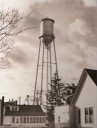
Hiram Blair built a residence on the ground now occupied by the city water
tower, and later built an addition thereto, and in 1870 opened the Sheridan
House, which from that time was the leading hotel for many years. H. C. Vanlyn
came from New York in 1867 and bought the residence property later owned by A.
G. Cox on Lincoln street. On the northwest corner of these lots he built a
building and the next year he and John F. Beebe put in a stock of boots and
shoes. The firm was Vanlyne & Beebe. On the east side of this was a little annex
in which Cleve Niles opened the first barber shop. He afterwards sold out to
John Booth and he to Joe Zimmerman in 1871.
Mem Victory, the eldest of the Victory boys, had been busy since his arrival
from New York in 1859. He had worked in the woods in the winter and with a
threshing outfit every fall and had an eye all the time for business. During
1868 he and F. D. Stone formed a co-partnership and went into the drug business.
The partnership continued about a year when Alfred Bolton bought Stone out and
the firm was Bolton & Victory, Mr. Bolton being the druggist and Mr. Victory
attending to the other duties. They continued together in business until Mr.
Bolton's death in 1870, when John F. Stone bought the interest from Mrs. Bolton
and the firm became Stone and Victory and so continued for more than a decade.
In 1867 Madison Searl built a store on the north side of Lincoln street, and he
with his brother Ambrose and a man by the name of Cook put in a stock of
hardware and continued under the firm name of Cook, Searle's & Co. until the
store was destroyed by fire some years later. Fredrick Dittmer and family came
in 1868 from Germany and started a shoe shop in a frame building where Acker &
Halske's saloon now stands. Later when his son Gus became sixteen years of age
they formed a partnership and put in a stock of boots and shoes and did a
thriving business. After the death of his father Gus closed out the business in
1894 to enter another line of work. W. H. Waterbury, who had lived on what is
now the Walter Green farm, in Thompson Valley, came to the village with his
family and made their home in the house which now stands east of the Park house
and from that time until his death was active in business and political affairs.
In those days the farmers brought their grain to market, but as there was no
railroads to haul it away the problem was a serious one. Charles Buckman had
built a large building on the corner of Lincoln and Stone streets. Livermore,
Heard & Waterbury used this as a warehouse in which to store the grain they
bought. Warren Bros. also bought grain at that time. The market for this grain
was Sparta, the nearest railway point. The grain was hauled by teams and the
trip occupied the time from Monday morning to Saturday night and the grain was
exchanged for merchandise to be again exchanged for grain.
Silas Perry and family moved in from Scott's Valley in 1869, and with a man by
the name of Turner he built a flat. The venture was not a profitable one and was
later abandoned. In 1869 William and Lorenzo Bennett built the building now
standing on the corner of Stone and Buckman street, known then as Bennett's
Hall. It was the largest building in the village. William Bennett started a
blacksmith shop on the first floor, while the second story was a hall devoted to
public use. Here was the scene of many glorious times, both social and
political, and for many years was the only public hall. In a third story there
was a small hall which for several years was the meeting place of the I. O. O.
F. About this time -- 1869 -- the first furniture store was started by a man
named Tibbits in a building located where O. F. Braleger's hardware store now
stands. Mr. Tibbits later sold the business to W. E. Goodnow.
The first exclusive clothing store was started in 1868 by William "Bill"
McClure, who had come from Sparta. He kept a good stock and did a prosperous
business.
L. L. Williams came from Ohio in 1869. He came to work in the post office for
Harris Searl, but as the job was not just to his fancy he rented a little
building at the rear of the Searl & Carter store, on Stone street, and put in a
small stock of books, stationery, confectionery and small notions. He prospered
from the start and after a couple of years he moved to where Paul's drug store
now is, put in a stock of jewelry and a larger stock of stationery and notions
and continued to prosper.
E. J. Horton and William Fulton built a blacksmith shop on the present site of
John Anderson's shop, and Mr. Fulton was the smith in charge. Horton sold out to
Eph Crockett, and John Anders, who had arrived in the village in 1869, bought
them out. He moved the shop across the street in 1874 and built a brick shop.
In the early days, as now, there frequently arose disputes between neighbors. To
assist in the settlement of these disputes there were no regular attorneys and
so the disputants adopted a better method. William Young, who was an oracle in
the community would be called upon to espouse the cause of one disputant while
Harris Searl would take up the side of the other. The case would then come
before the justice of the peace, John F. Stone, or some other, and a
determination of the matter would be made in due and lawful form. If the
problems were too knotty, Alexander Meggett or W. P. Bartlett would be summoned
from Eau Claire. About 1867 B. F. Chase came from the southern part of the state
and opened a law office. R. D. Campbell opened a law office in 1868 and a few
years later J. C. Crawford came to compete with them and nurture litigation.
From those days the village was not in legal darkness.
There was no regular doctor in those days either, and William Young, whose
father was a doctor, cared for the physical ills of the people. He became quite
famous for his treatment of certain ills, especially cancer, for which he had an
almost certain remedy. Later Dr. D. C. Spencer came, about 1868, and established
a good practice which he continued for many years. Dr. H. P. Waldrous soon
followed. He was a homoeopathist and became famous for his peculiarities and for
his many cures.
About 1867 "Changhi" Chandler, famous in those days as a newspaper man, started
the Augusta "Herald." After about a year he sold out to Charles Warren and soon
after Warren sold to a man by the name of Brown. The "Herald" was discontinued
after a couple of years and the village was without a newspaper until 1874. W.
H. Waterbury was appointed postmaster in 1869, succeeding Harris Searl, and
moved the office into the building later occupied by A. E. Perry as a barber
shop. He also retired from partnership with Heard & Livermore and put a stock of
general merchandise in the building with the post office. Prior to 1869 Tom and
Tim Tusker had built the shop which stands on the southwest corner of Stone and
Spring streets, later occupied by the Victory Mercantile Company as a warehouse.
They conducted a blacksmith and wagon shop and did a prosperous business. They
sold the shop later to Austin Russell, and it was occupied for a time by P.
Bonnot as a wagon shop. A. W. Russell and son Ira had built a store building on
the southeast corner of the Lincoln and Spring streets, and occupied it for a
time with a stock of dry goods, Mrs. Russell keeping a millinery store in the
rear part. The Ricks came about this time, John, Michael and Charles, with their
families and soon became industrial factors. They had come from Germany about a
year before and settled, briefly, at Ripon, Wisconsin, in 1868, coming here the
following year. August, the oldest of the Michael Rick family, coming a year
later, 1870. Ren Halstead had succeeded Harris Searl as landlord of the Augusta
House, and he, in turn, had been succeeded by H. Sargent and he by Henry Welch.
E. F. Ober, who had come from Vermont, a young man of good address, worked in
the hotel for Welch, clerking and attending to business generally. Ed Matteson,
another young man, worked in the store for "Bill" McClure, as clerk.

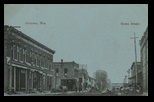
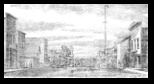
[Augusta Wisconsin Lincoln Street in
1874]
Jerome Hardy was running a saloon, and a man by the name of Hanson kept a tailor
shop just where cannot be learned at this late date. A building had been built
between Bolton & Victory's and the corner, and A. C. White occupied it with a
meat market. W. H. Roberts had a wagon shop and J. L. Ball had built the
planing mill in 1878. In the beginning of 1869 the West Wisconsin railway had
been completed to Humbird and that place became the base of supplies for
Augusta. Freight and stage lines were established, and business was on the boom.
Harvey Plumley came that year and went into partnership with Hackett and the
Stone Bros. in the hardware business. Robert McGwine, a man of extraordinary
talent, had a harness shop. He was a good workman, but so fond of liquor that
his labor was too frequently interrupted by his worship at the bacchanalian
shrine. Charles and John Taggart arrived, the former in 1869 and the latter in
1870, both hustlers, to be heard from later. The railroad came in the fall of
1869 and business took a new life. A depot was built, telegraphic communication
established with the world and Augusta was on the map. Jim Smith was the agent
in charge at the depot and things moved at a more lively gait. An old barn that
Charles Buckman had built somewhere just east of where the Methodist church now
stands, had been moved to the railway right of way by J. C. Hackett and
established as a flat warehouse. John Hurst occupied one end of it and C. A.
Kirkham the other end, both to buy grain, wheat principally. Buckman's second
addition to the village plat was made in 1868 and Stone's addition in 1869. S.
J. Hutchins purchased the interest of the Stone Bros. in the hardware store and
later bought out Hackett and Plumley. Frank Searl worked for him in the store at
that time.
In 1872 L. O. Hickot succeeded Jim Smith as agent at the station and
two new elevators were built, one by Warren Bros., since burned, and one by L.
Ermingham & Co., grain dealers, of Milwaukee. Then P. Brown and his son-in-law,
a Mr. Eaton, came from Black River Falls and bought out the S. J. Hutchins
hardware stock. The Jacksons, father and son, of whom no previous mention has
been made, had been here for some time doing various lines of business, and at
the present time the elder Jackson ran the Sheridan House. John O'Brien bought
out A. C. White's meat market and A. C. Rick came from Ripon and the two started
a market. Later William Hertzke, who came from Ripon, bought out Mr. O'Brien and
he and Mr. Rick continued the business for several years. Meanwhile the two
buildings on the southwest corner of Stone and Lincoln streets had burned and
Stone and Victory built a brick building on that corner and occupied the same
with an enlarged stock of drugs and groceries. Harvey & Plumley built a basement
next west, but did not finish the building. George M. Bell, who had been a clerk
in the store for Warren Bros. occupied the store vacated by Stone & Victory,
with a stock of general merchandise. O. A. Williams came from Ohio in 1871 and
entered into partnership with his brother, L. L. Williams. The following year
they built a building on the south side of Lincoln street and put in an enlarged
stock, adding watches, clocks and jewelry. H. Fust had a tailor shop in the
rear. In 1874 S. McClatchie, who had been in the employ of Loomis, Gallette &
Breese, at Portage, Wisconsin, came and as the representative of that firm
bought the Josephus Livermore stock in the old building on the corner. It was
rather a gloomy prospect for S. M. in the little tucked up place and he soon
arranged to move into the place where George M. Bell had been, the old Bolton
and Victory building. Ira B. Bradford, who had been admitted to the bar in 1873,
came with his wife to the village. They began housekeeping in rooms, upstairs in
the Humphrey house, and Mr. Bradford opened a law office in rooms upstairs in a
frame building on the south side of Lincoln street. How well he succeeded the
after history of Augusta will disclose. Griff O. Jones came in 1874 from
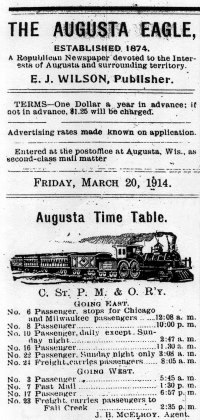
Columbia county, Wisconsin, and started the Augusta "Eagle," the first office
being upstairs in the frame building being occupied by Vantyne & Beebe on the
south side of Lincoln street. Later when the bank block was finished he moved
upstairs over where the post office now is, and the "Eagle" has since been
published from that place.
In 1875 Williams Brothers built a brick building two stories on the basement
which Harvey Plumley had built near the corner, and they occupied the same that
year, again increasing their stock. Fred Williams, who was then but a kid, had
arrived from Ohio in 1873. Tom Hoefer was working for Williams Bros. as jeweler
and watchmaker. From him Fred learned the trade, and when the stock was removed
to the new building Fred was ready to take charge of the work, which he did.
John Anderson built his brick shop in 1874 and continued to pound away as though
he had to. The same year I. Bradford moved his office into the rooms over the
new Williams Bros. store. He and Russell Hackett started the Augusta bank that
year in the same rooms and at the start L. C. Humphrey was the cashier. The
Beebe block was first built in 1876, a two-story brick building, double front
below and a hall in the whole of the second story. "Bill" McClure moved his
clothing stock from across the street into the west half of the new building,
and Loomis, Gallette & Breese occupying the east half, S. M. Clutchie in charge.
E. F. Ober was a salesman with the firm at that time. Up to this time Augusta
had never had a large fire. Only three of the business buildings were of brick
and the time was ripe for a purging.
[This building, built in 1878 as a bank, now houses the Augusta Wisconsin Public
Library]
Prior to 1877 there were two institutions of which no mention has yet been made.
N. Marte came about 1870 and started a furniture store in a building just south
of where the O'Brien & Cutland livery stable stood. He was a thorough workman
and did a good business. Later he moved to the north side of Lincoln street. L.
A. Brace and B. H. Walrath started a dry goods store in the A. W. Russell
building on the southeast corner of Stone and Spring streets. Mr. Levi Walrath
did tailoring in the rear of the store and his wife continued the millinery
business which Mrs. Russell had established. In 1877 the buildings on the
northeast corner of Stone and Lincoln streets were burned to the ground. Rick
and Hertzke's market occupied the middle building, Lupps and Marte had a saloon
in the corner building and the north building was unoccupied. As soon as matters
could be adjusted arrangements were made to rebuild. Bradford & Hackett had
bought the corner lot. A. C. Rick owned the middle lot and John F. Stone the
north lot. They arranged to build the block together and it was accordingly
done. It was built of solid brick and at the time and for several years was the
finest building in the city. When completed the Augusta bank was moved into the
corner and Mr. Bradford occupied the upper front with his law office and A. C.
Rick occupied the middle portion. Who first occupied the north portion is beyond
the knowledge of the writer. Later it was occupied by Fuller Bros., who came
from Columbus, Wisconsin, with a stock of dry goods and clothing. At the
beginning of 1880 the space from Beebe's block to the Williams Bros. store was
occupied by Warden buildings. During that year a fire broke out and burned the
whole row. This fire was a great cleaning up, and the following year the row was
rebuilt. P. Brown, who had bought out his son-in-law, Eaton, built a substantial
brick building next to Williams' and occupied it with his hardware business. J.
F. Beebe built on his lots from his block to where Aug. Arndt's furniture store
now is. Nick Marte built the furniture store and occupied the same with his
business. J. R. Rundlette built the next east for a drug store, and H. C.
Vantyne, who had succeeded Vantyne & Beebe, built next for his shoe store. S.
Axtel, who had come from Columbus and started a dry goods store, following Brace
& Walrath in the A. W. Russell building built the next, a large store building
which he occupied with his business. This left but a narrow, vacant lot in the
burned district. On this vacant lot B. F. Brown built in 1883. In 1880 Plummer &
Finch came from Reedsburg and bought the grist mill from John F. Stone and took
possession June 21 of that year. They remodeled the mill, making it a completely
equipped modern mill. Later they put in a steam power plant to relieve the water
power.
G. W. Purnell came from Merrillan in 1880 and put a large stock of hardware in
the west half of the Beebe block, and cut considerable ice for a couple of
years, then moved back to Merrillan. Dr. E. M. Rogers came in 1882 from Dodge
county and opened dental offices over what is now Rick's saloon. Later he moved
into the rooms over the Williams store and still later into the building where
Dr. D. W. Babcock had his office. Ed Ober and Henry McBain had bough an interest
in the Breese, Loomis, & Co. stock and the firm became known as E. F. Ober & Co.
W. H. Dodge, who had occupied the little old building, corner moved the same
into the frame building first west of the Beebe block. J. C. Hackett and W. D.
Hebard, who had been in the machinery business for years, bought the stock from
him in 1880 and continued the business there for a couple of years. In 1882
Hackett and Hebard moved into the building vacated by Parnell. In 1883 W. S.
Cox, C. A. Cox and Frank L. Clarke formed a co-partnership under the firm name
of Cox Bros. & Clarke, and on September 1, 1883, opened a stock of general
merchandise in the B. F. Brown building. After three years they moved into the
Beebe block after the fire of 1886.
In 1886 J. B. Button was appointed postmaster by President Cleveland to succeed
W. H. Waterbury. He moved the office into a frame building west of the Beebe
block. That winter fire again visited Lincoln street, burning the Beebe block
and west from there to as far as where the "Times" office stood in 1906. To the
east it burned to the Marte store and then crossed the street, taking everything
from W. F. Rick's saloon to where Pehlke & Honadel now are. After this fire the
post office was moved to the bank block. In the spring of that year Frank L.
Clarke was appointed postmaster to succeed J. B. Button. John F. Beebe proceeded
to rebuild most of the burned district on the north side of Lincoln street.
Shortly after the big fire the old building on the corner of Stone and Lincoln
streets, occupied by Whiting as a restaurant, was burned. E. F. Ober & Co.
bought the lots and at once built the brick building that now stands and
occupied the same with their business. John F. Beebe rebuilt on his vacant lots
and when the original Beebe block was rebuilt the west half was occupied by
Hackett & Hebard. The same year Cox Bros. & Clarke moved from the B. F. Brown
building next to Hackett & Hebard.

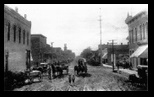
[Augusta
Wisconsin Lincoln Street in 1907]
The Augusta "Times" was started January 1, 1890. It
was purchased by Frank L. Clarke and C. W. Warner, and about two years later
Warner retired and Clarke continued the publication until January 1, 1904, when
E. G. Herrell purchased the outfit. In 1883 F. E. Williams bought the watch,
clock and jewelry business from his brothers and conducted the same at the old
stand for a time. Later he moved into the B. F. Brown building. S. Axtel sold
his store and business in 1889 to Strauss and Levy, and in 1898 Mr. Levy bought
the Strauss interest. F. Dauffenbach came in 1889 and bought the hardware
business of P. Brown. In 1897 he sold to H. F. Erchler, who came from Reedsburg,
and two years later Erchler sold to O. F. Brager. The Beebe block was again
visited by fire in 1894. It was occupied at the time by Cox Bros. in one part,
and Hackett & Hebard in the other. Hackett & Hebard did not resume; Cox Bros.
retired during the time between the burning of the building and its rebuilding.
Taken from the "History of Eau Claire County, Wisconsin, Past and Present,
1914", pages 583 through 597.
Images added for this web page
====================================================================
USGENWEB NOTICE: In keeping with our policy of providing free information on the
Internet, data may be used by non-commercial entities, as long as this message
remains on all copied material. These electronic pages may NOT be reproduced in
any format for profit or for presentation by other persons or organizations.
Persons or organizations desiring to use this material for purposes other than
stated above must obtain the written consent of the file contributor, or the
legal representative of the contributor, and contact the listed USGenWeb
archivist with proof of this consent. The submitter has given permission to the file permanently for free access.
This history was contributed for use in the Augusta Wisconsin Web by: Nance
Sampson <nsampson@spacestar.net>
November 18th 2003
====================================================================
[Home]
[About Augusta] [Local
Services] [History] [Businesses]
[Lincoln Street] [The
Wood Shed]
[Dells Mill]
[Maps] [Churches]
[Camp/Lodge] [Events]
[Local Scenes] [Links]
[Register]

The
Augusta Wisconsin Web is underwritten by The Wood Shed of Augusta Wisconsin, The Wood Shed of Bonduel Wisconsin and The Wood Shed of Cambridge Wisconsin www.woddshedheirlooms.com for great Amish Furniture |